US history · interactive map
13 Colonies Map
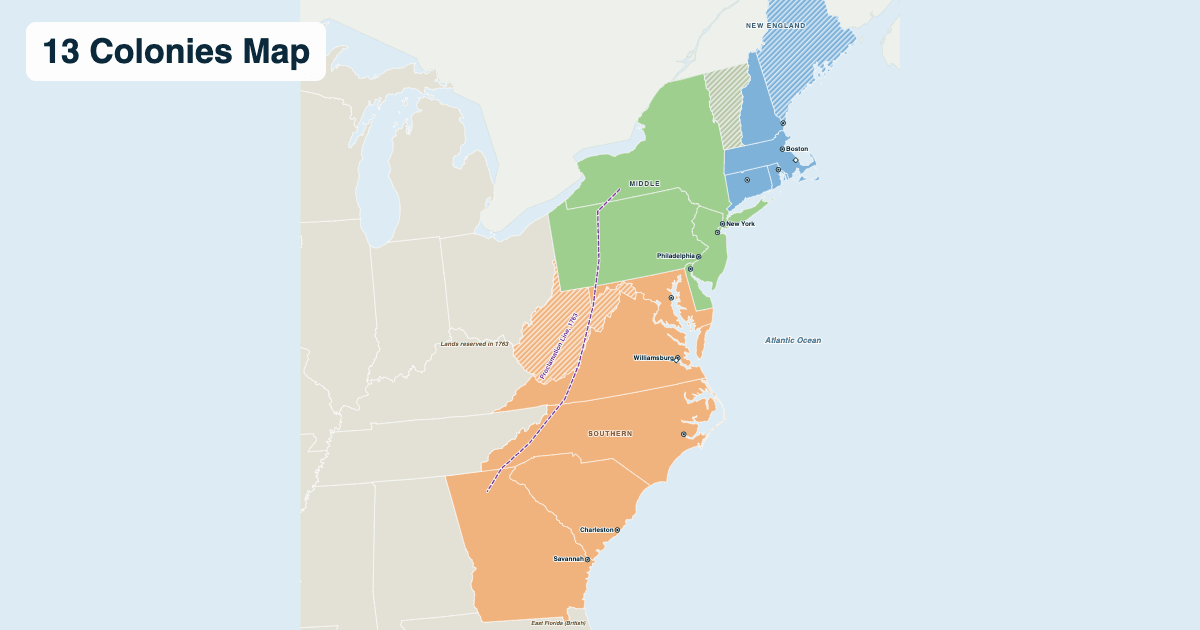
A labeled map of the 13 colonies: the British colonies on the eve of the American Revolution, in their three regions, the New England, Middle and Southern colonies. Hover over or tap a colony for when it was founded and by whom; the dots are the colonial capitals in 1775. Switch the names off for a blank map.
- New England colonies
- Maine (part of Massachusetts)
- Middle colonies
- Southern colonies
- Western Virginia (part of Virginia)
- Vermont (claimed by New Hampshire and New York)
Colonies are drawn with the borders of today's states. The colonies' charters claimed land far to the west, but the Proclamation of 1763 closed the land beyond the Appalachian Mountains to settlement.
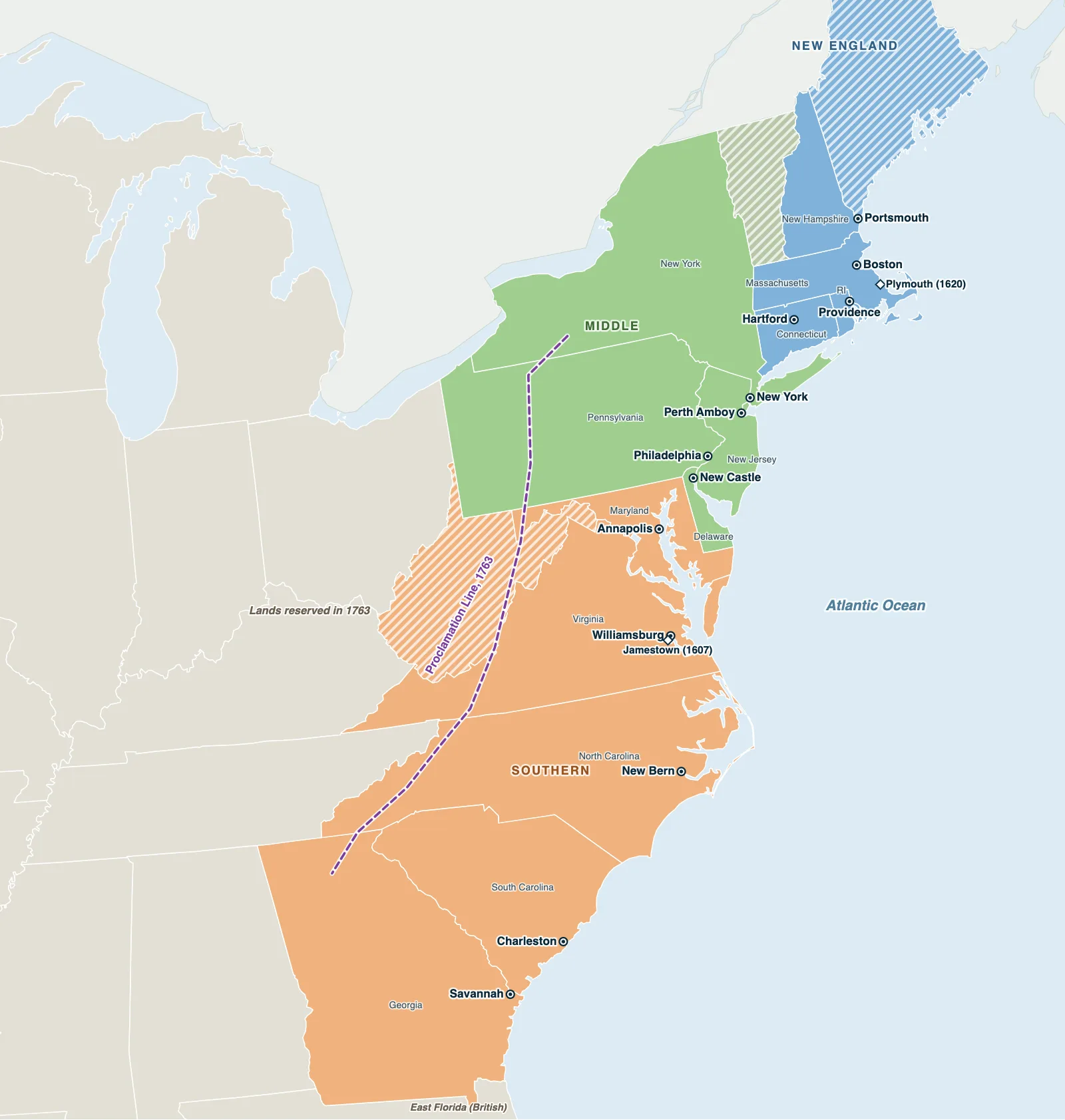
Hover over or tap a state, line or place for details. Use the key to show or hide lines.
Test yourself on this map
Find US States on the Map · Click each state we name
Printable 13 Colonies Map
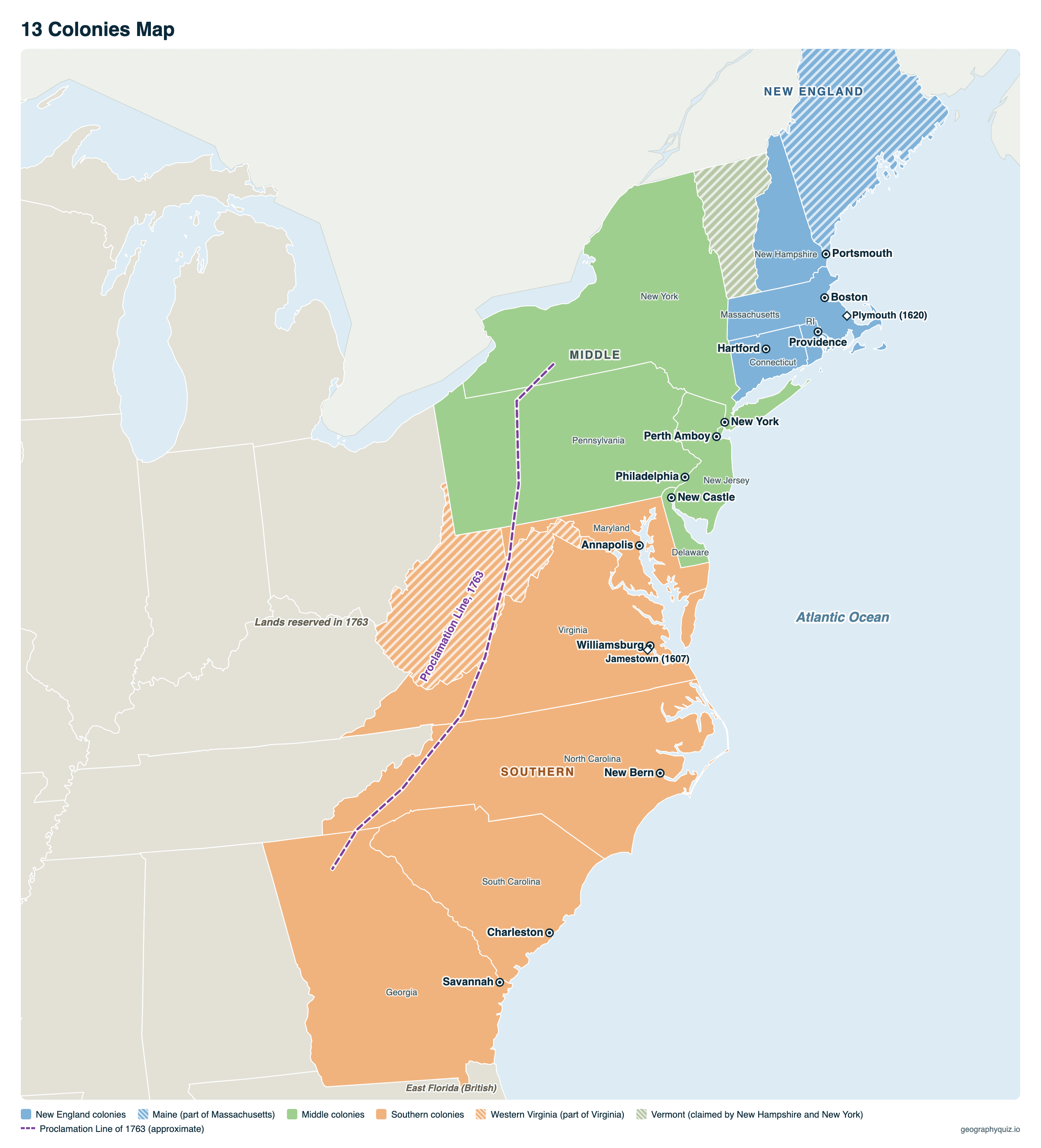
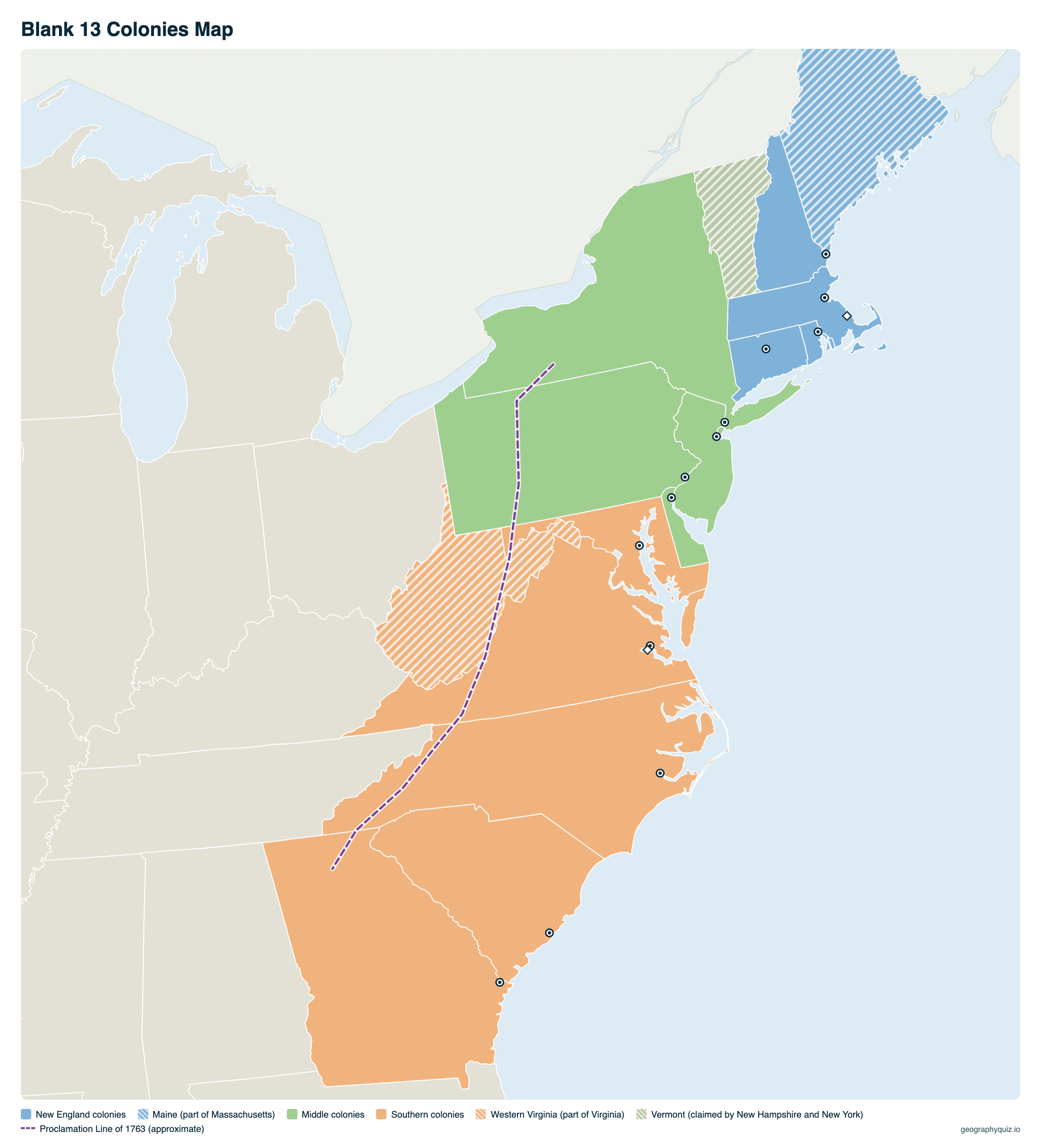
Free to print for class and home: the 13 colonies colored by region, with their capitals, Jamestown, Plymouth and the Proclamation Line, on one landscape A4 or US Letter page. For label-the-colonies sheets with a word bank, a coloring page and map questions, see the 13 Colonies Map Worksheets. The blank version has the same map with no names on it, for labeling in class.
Key facts
- Colonies
- 13
- Regions
- New England (4), Middle (4), Southern (5)
- First colony
- Virginia (Jamestown, 1607)
- Last colony
- Georgia (1732)
- Largest city in 1775
- Philadelphia
- Independence declared
- July 4, 1776
- First to ratify the Constitution
- Delaware, December 7, 1787 (the First State)
The 13 colonies: founding, capitals and statehood
In order of founding, from Jamestown in 1607 to Georgia in 1732. The last column is the order in which each former colony ratified the US Constitution and became a state.
| Colony | Founded | Founded by | Region | Type (1775) | Capital (1775) | Ratified the Constitution | Order |
|---|---|---|---|---|---|---|---|
| Virginia | 1607 | Virginia Company of London (Jamestown) | Southern | Royal | Williamsburg | June 25, 1788 | 10 |
| Massachusetts | 1620 | Pilgrims at Plymouth; Puritans at Massachusetts Bay (1630) | New England | Royal | Boston | February 6, 1788 | 6 |
| New Hampshire | 1623 | John Mason and English settlers | New England | Royal | Portsmouth | June 21, 1788 | 9 |
| New York | 1626 | Dutch (New Netherland); English from 1664 | Middle | Royal | New York | July 26, 1788 | 11 |
| Maryland | 1634 | Cecil Calvert, Lord Baltimore | Southern | Proprietary | Annapolis | April 28, 1788 | 7 |
| Connecticut | 1636 | Thomas Hooker and Puritans from Massachusetts | New England | Charter | Hartford and New Haven | January 9, 1788 | 5 |
| Rhode Island | 1636 | Roger Williams | New England | Charter | Newport and Providence | May 29, 1790 | 13 |
| Delaware | 1638 | New Sweden (Swedish); English from 1664 | Middle | Proprietary | New Castle | December 7, 1787 | 1 |
| North Carolina | 1653 | Settlers from Virginia; Carolina chartered 1663, separate colony 1712 | Southern | Royal | New Bern | November 21, 1789 | 12 |
| New Jersey | 1664 | Lord Berkeley and Sir George Carteret | Middle | Royal | Perth Amboy and Burlington | December 18, 1787 | 3 |
| South Carolina | 1670 | Lords Proprietors of Carolina (Charles Town); separate colony 1712 | Southern | Royal | Charleston | May 23, 1788 | 8 |
| Pennsylvania | 1681 | William Penn | Middle | Proprietary | Philadelphia | December 12, 1787 | 2 |
| Georgia | 1732 | James Oglethorpe | Southern | Royal | Savannah | January 2, 1788 | 4 |
New England, Middle and Southern colonies
The New England colonies (Massachusetts, New Hampshire, Rhode Island and Connecticut) were founded mostly by Puritans and other religious dissenters. Thin, rocky soil and long winters meant small family farms; people lived from fishing, shipbuilding, timber and trade, and towns grew around their meetinghouses. Boston was the region's port and largest town.
The Middle colonies (New York, New Jersey, Pennsylvania and Delaware) had richer soil and milder winters. They grew so much wheat and corn that they were called the breadbasket colonies, and they were the most mixed: Dutch, Swedish, German, Scots-Irish and English settlers, with Quakers in Pennsylvania and religious toleration. Philadelphia and New York were the busiest ports in the colonies.
The Southern colonies (Maryland, Virginia, North Carolina, South Carolina and Georgia) had the longest growing season. Large plantations grew tobacco in Virginia and Maryland and rice and indigo in the Carolinas and Georgia for export to Britain, worked by enslaved Africans; by 1775 enslaved people were about two-fifths of the Southern colonies' population.
Royal, proprietary and charter colonies
By 1775 the colonies were governed in three ways. Eight were royal colonies (New Hampshire, Massachusetts, New York, New Jersey, Virginia, North Carolina, South Carolina and Georgia): the king appointed the governor and his council, and the colonists elected an assembly. Three were proprietary colonies (Pennsylvania, Delaware and Maryland), owned by a family, the Penns and the Calverts, who chose the governor. Connecticut and Rhode Island were charter colonies, which elected their own governors under charters granted by the king.
Most colonies changed type over time. Virginia began as a company colony and became royal in 1624; the Carolinas and New Jersey began as proprietary colonies and became royal; Georgia was run by trustees until 1752.
The Proclamation Line of 1763
After Britain won the French and Indian War in 1763, King George III closed the land west of the Appalachian Mountains to colonial settlement, reserving it for Native American nations. The line followed the watershed between the rivers that flow to the Atlantic and those that flow to the Mississippi. Many colonists, who had fought the war partly to open those lands, ignored or resented it, one of the grievances that led to the Revolution.
The colonies' charters still claimed land far to the west: Virginia claimed Kentucky and the Ohio country, North Carolina the future Tennessee and Georgia the land to the Mississippi. After independence the states gave these claims to the national government, which organized them as territories and new states.
The other British colonies
The 13 were not Britain's only colonies in North America. In 1775 it also held Quebec, Nova Scotia and Newfoundland to the north, East and West Florida to the south, the Hudson's Bay Company's lands around Hudson Bay, and island colonies in the Caribbean such as Jamaica and Barbados. None of them joined the Revolution: Quebec's French-speaking Catholics had been British subjects only since 1763, and an American invasion of Quebec in 1775–1776 failed.
Frequently asked questions
What were the 13 colonies?
Virginia, Massachusetts, New Hampshire, Maryland, Connecticut, Rhode Island, Delaware, North Carolina, South Carolina, New York, New Jersey, Pennsylvania and Georgia: the British colonies on the Atlantic coast of North America that declared independence in 1776 and became the first 13 states.
What were the New England colonies?
Massachusetts, New Hampshire, Rhode Island and Connecticut. Maine was part of Massachusetts until 1820, and Vermont, claimed by both New Hampshire and New York, was not one of the 13.
What were the Middle colonies?
New York, New Jersey, Pennsylvania and Delaware. Their fertile soil made them the breadbasket colonies, and they were the most diverse in religion and nationality.
What were the Southern colonies?
Maryland, Virginia, North Carolina, South Carolina and Georgia. Their plantations grew tobacco, rice and indigo for export, worked largely by enslaved Africans.
What was the first of the 13 colonies?
Virginia. Jamestown, founded on May 14, 1607, was the first permanent English settlement in North America. The last of the 13 was Georgia, founded by James Oglethorpe in 1732 (Savannah, 1733).
Why was Georgia founded?
James Oglethorpe and a group of trustees founded Georgia in 1732 as a buffer between South Carolina and Spanish Florida, and as a fresh start for poor English settlers, including people released from debtors' prisons.
Were Maine, Vermont and Florida part of the 13 colonies?
No. Maine was part of Massachusetts, Vermont was disputed land between New Hampshire and New York (it became the 14th state in 1791), and Florida was a separate British colony from 1763 that stayed loyal to Britain and went back to Spain in 1783.
What is a royal colony?
A colony governed directly by the king, who appointed its governor and council. By 1775, 8 of the 13 colonies were royal colonies; Pennsylvania, Delaware and Maryland were proprietary colonies, run by their owners, and Connecticut and Rhode Island were charter colonies that elected their own governors.
Why was Canada not part of the 13 colonies?
Quebec, the heart of today's Canada, was French (New France) until Britain won it in 1763, so its French-speaking Catholic people had been British subjects for only a few years and had little in common with the Protestant colonies to the south. Quebec and Nova Scotia were separate British colonies that did not send delegates to the Continental Congress, and an American invasion of Quebec in 1775–1776 failed. Much of the rest of Canada was the Hudson's Bay Company's fur-trading land.
Which colony was first to become a state?
Delaware, the first to ratify the US Constitution, on December 7, 1787, which is why it is called the First State. Rhode Island was the last of the 13, on May 29, 1790.
Sources
- State boundaries: US Census Bureau, cartographic boundary files (2024); colonies are drawn with modern state borders.
- Founding dates, capitals and ratification dates: National Archives (The Constitution: ratification), Library of Congress (colonial history collections) and the National Park Service (Jamestown, Plymouth and colonial sites).
- Proclamation Line: drawn approximately along the Appalachian watershed, after the Royal Proclamation of October 7, 1763.