Jordan vs US size comparison
How Big Is Jordan Compared to the US?
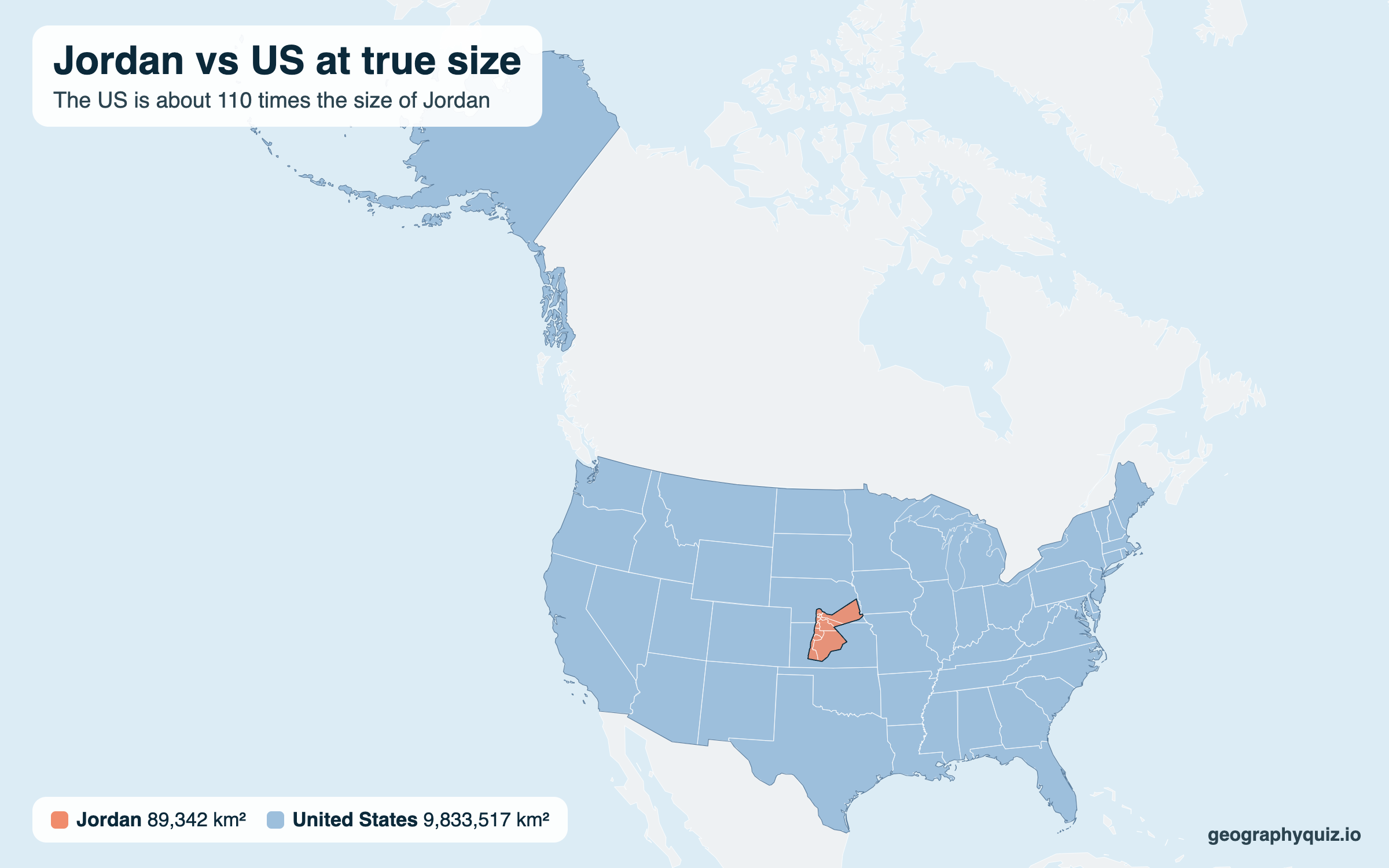
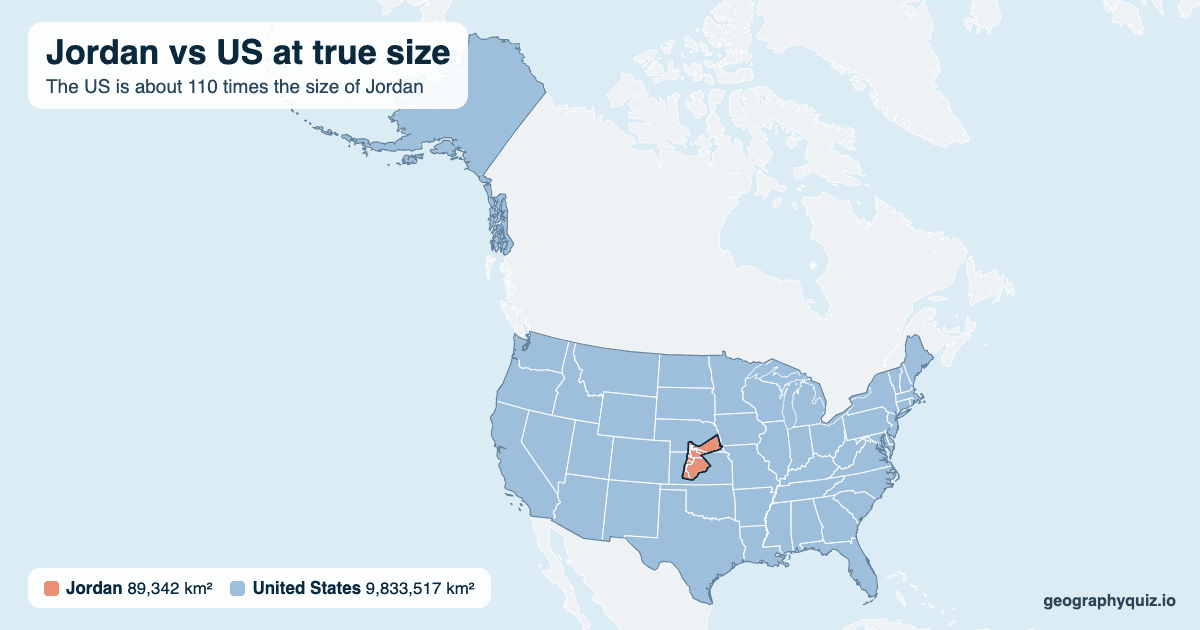
The US is about 110 times the size of Jordan. Jordan is about 3.7 times as densely populated. Drag Jordan over the US below to see the difference at true size.
Hawaii and the territories are not drawn.
Printable Jordan vs US size comparison
Free to print or share: Jordan laid over the US at true size, with both areas, on one landscape A4 or US Letter page.
Key facts
- Area of Jordan
- 89,342 km² (34,495 sq mi)
- Area of the US
- 9,833,517 km² (3,796,741 sq mi)
- Size difference
- The US is about 110 times bigger
- Closest US state in size
- Maine (91,633 km²)
- Population (2025)
- Jordan 11,520,684; the US 341,784,857
- Jordan's rank by area
- 110th-largest of 197
How big Jordan is compared with the US
The US is about 110 times the size of Jordan: 9,833,517 km² (3,796,741 sq mi) against 89,342 km² (34,495 sq mi). Even the 48 contiguous states alone, without Alaska, could hold Jordan about 91 times. Jordan is bigger than 11 of the 50 US states and smaller than the other 39; the state closest in size is Maine (91,633 km²). It is the 110th-largest of the world's 197 countries, and the 30th-largest of 47 in Asia; the US is the third-largest.
Jordan has about 12 million people (2025), the 84th-most populous country in the world, against 342 million in the US. With 129 people per km² it is about 3.7 times as crowded as the US (35 per km²), the 74th-most densely populated country.
Jordan and the US on a world map
Jordan reaches from 29°N to 33°N; the US from 19°N to 71°N, with Hawaii in the south and Alaska in the far north. Most world maps use the Mercator projection, which enlarges places more the further they are from the Equator. It draws Jordan about 1.37 times its real size and the US about 2.3 times (Alaska far more than Florida). So on a normal world map the US looks about 185 times the size of Jordan, when it is really about 110 times. The equal-area map above shows the real difference.
Where Jordan is
Jordan's capital, Amman, is 9,530 km (5,920 miles) from Washington, D.C. as the crow flies. Jordan borders 5 countries: Israel, Iraq, Palestine, Saudi Arabia and Syria.
Jordan and US in numbers
| Jordan | US | Difference | |
|---|---|---|---|
| Area | 89,342 km² 34,495 sq mi | 9,833,517 km² 3,796,741 sq mi | The US is 110× bigger |
| Population (2025) | 11,520,684 | 341,784,857 | The US has 30× more |
| Rank by area | 110th-largest | Third-largest | of 197 countries |
| People per km² | 129 | 35 | Jordan is 3.7× denser |
| Capital | Amman | Washington, D.C. | 9,530 km apart |
| Neighbouring countries | 5 | 2 |
Jordan compared with US states
Frequently asked questions
Is Jordan bigger than the US?
No. The US is about 110 times the size of Jordan: 9,833,517 km² (3,796,741 sq mi) against 89,342 km² (34,495 sq mi).
How many times would Jordan fit into the US?
About 110 times (110). Into the 48 contiguous states alone, about 91 times.
Which US state is Jordan closest in size to?
Maine (91,633 km²). Jordan is about the same size as Maine.
Is Jordan bigger than Texas?
No. Texas is about 7.8 times the size of Jordan.
Which has more people, Jordan or the US?
The US: about 342 million people in 2025, about 30 times the 12 million in Jordan.
Why does Jordan look so small on a world map?
Most world maps use the Mercator projection, which stretches places more the further they are from the Equator. The US is further from the Equator than Jordan, so it is stretched more. On a Mercator map the US looks about 185 times the size of Jordan, not 110.
Where does Jordan rank by size?
Jordan is the 110th-largest of the world's 197 countries by total area and the 30th-largest in Asia. The US is the third-largest.
How far is Jordan from the US?
Jordan's capital, Amman, is 9,530 km (5,920 miles) from Washington, D.C. in a straight line.
Sources
- Areas: CIA World Factbook (total area, land and water). US states: US Census Bureau.
- Populations: World Bank, World Development Indicators (2025).
- Outlines are drawn on an equal-area projection, so their sizes on the map match their real areas.