US Letter · 1 page
Landforms Diagram
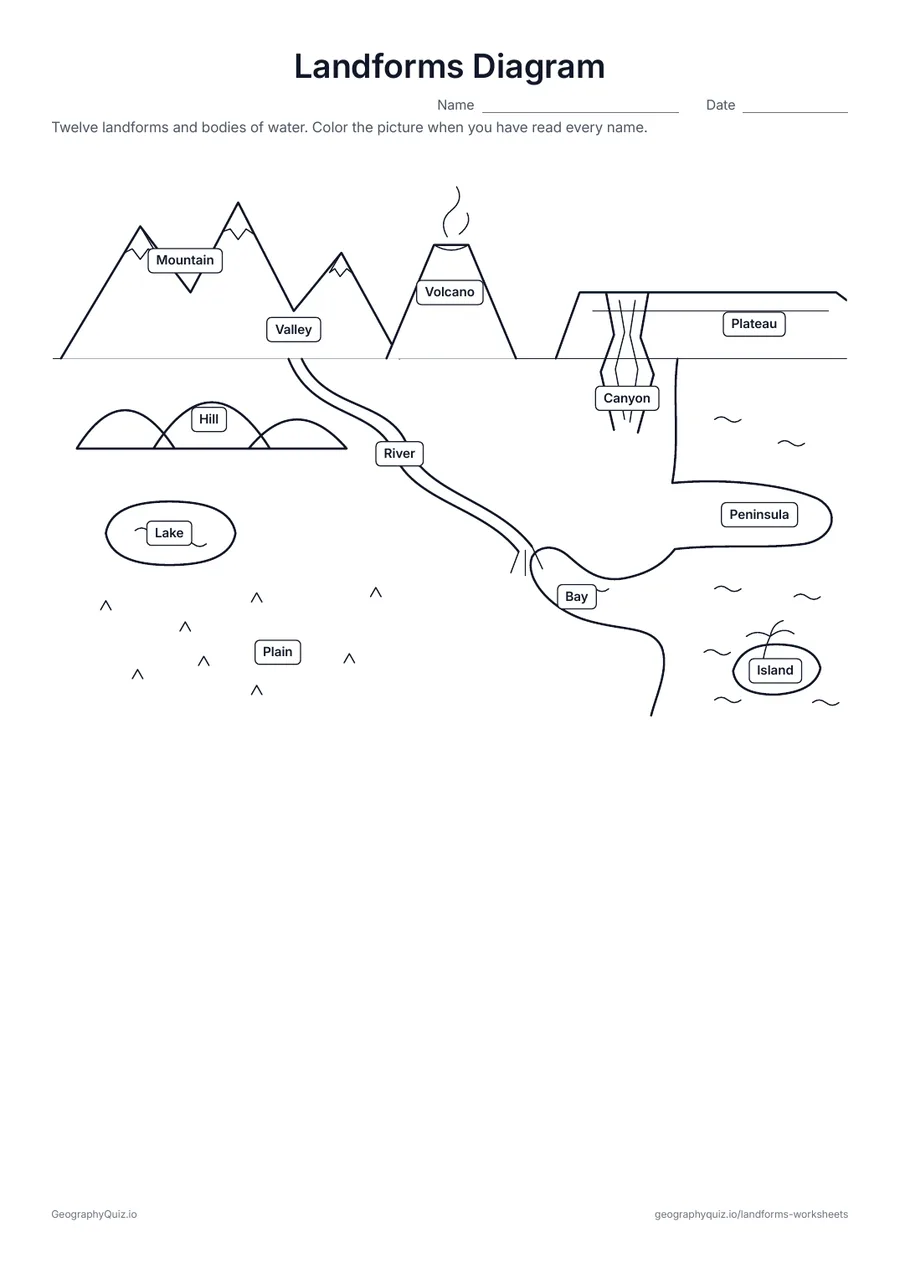
The landscape with all twelve landforms named – a poster for the wall and a reference for the other sheets.
Free teacher resource
Eight landforms worksheets built around one drawn landscape with twelve landforms and bodies of water – mountain, volcano, hill, valley, plateau, canyon, plain, river, lake, island, peninsula and bay: label them, color them, match each to its meaning, write your own definitions, solve a word search and a crossword, and design an island of your own.
Every sheet comes as an A4 and a US Letter PDF.Print it, then play it
US Letter · 1 page
The landscape with all twelve landforms named – a poster for the wall and a reference for the other sheets.
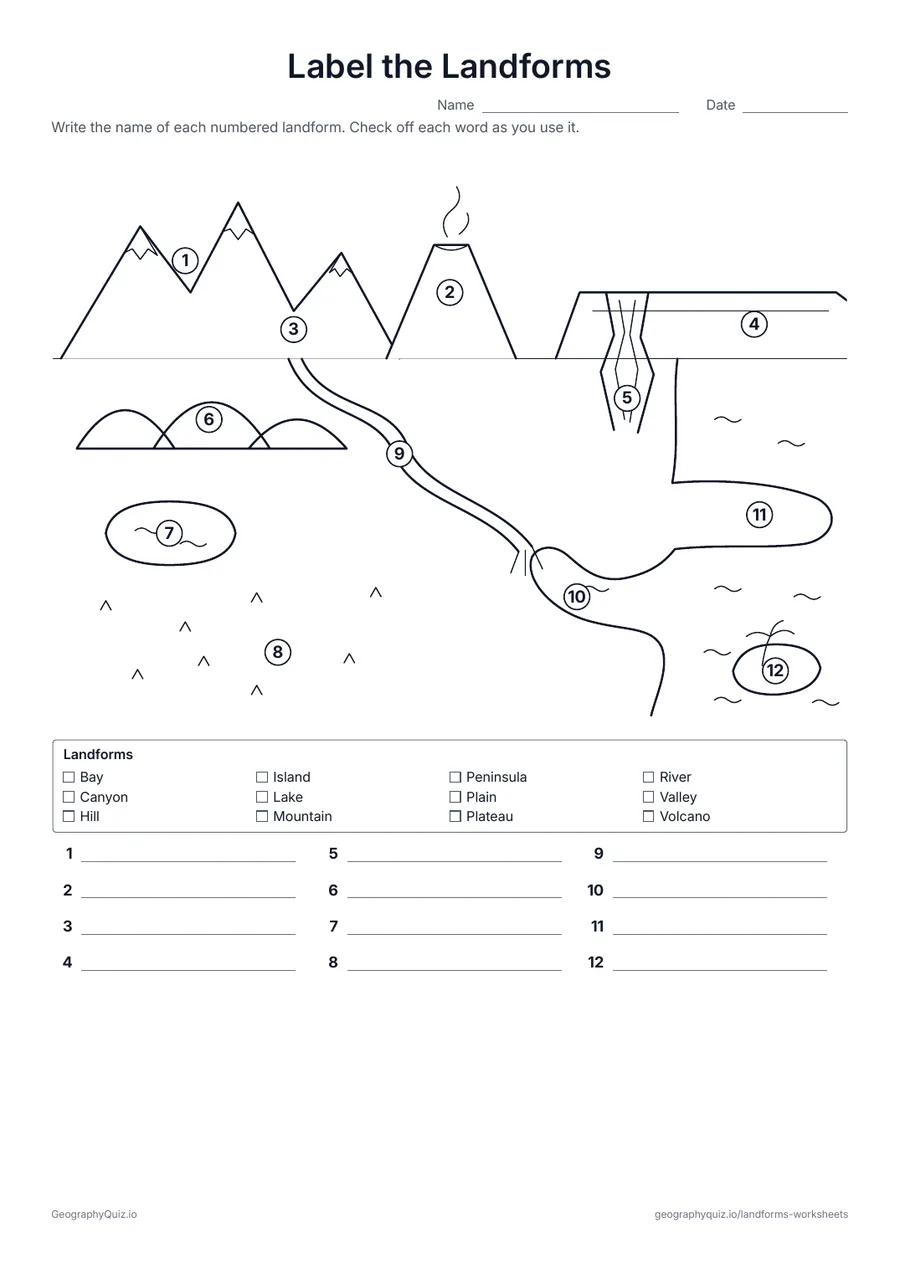
US Letter · 1 page
Twelve numbered landforms and a word bank. Students write each name on its line.
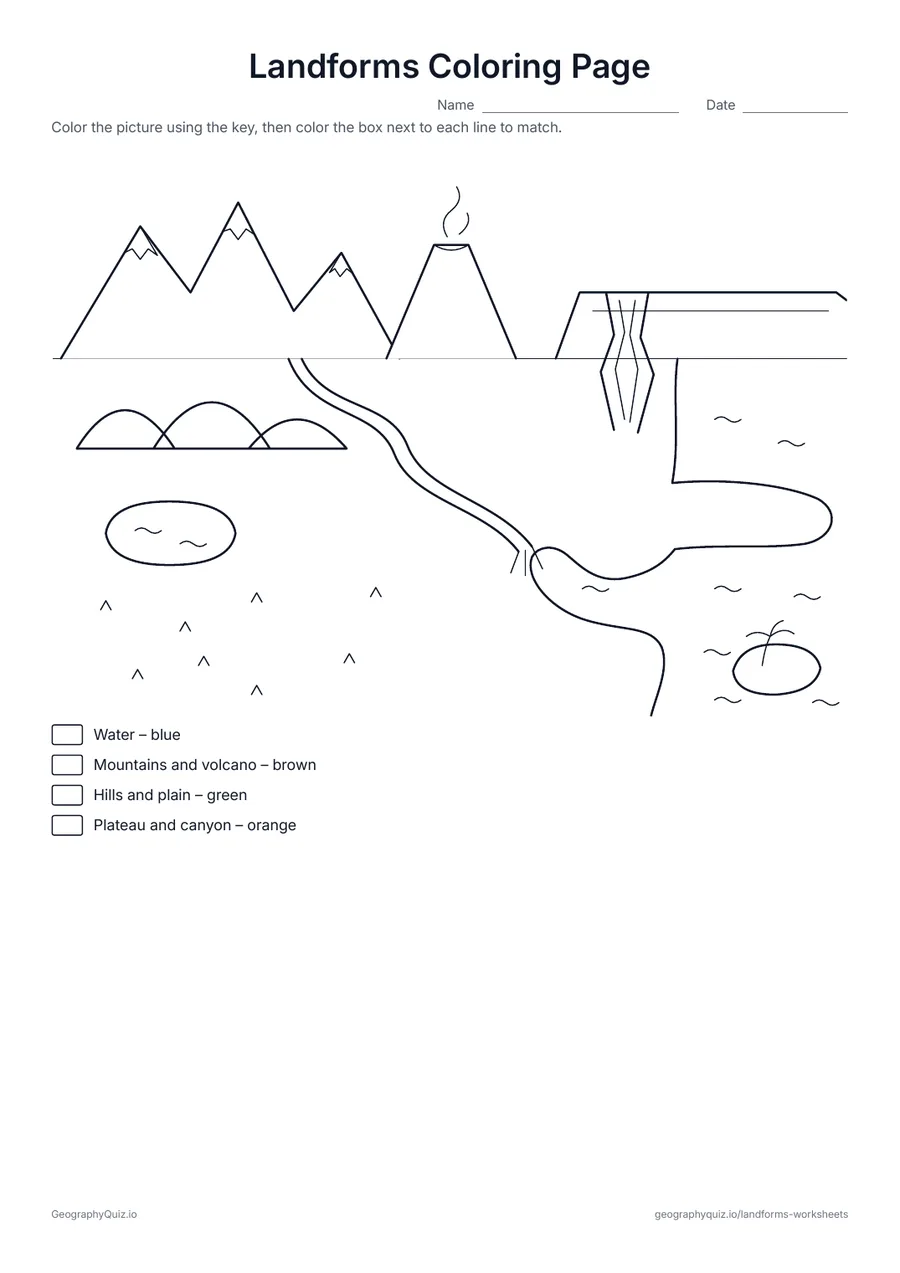
US Letter · 1 page
The landscape to color with a four-color key: water blue, mountains brown, hills and plain green, plateau and canyon orange.
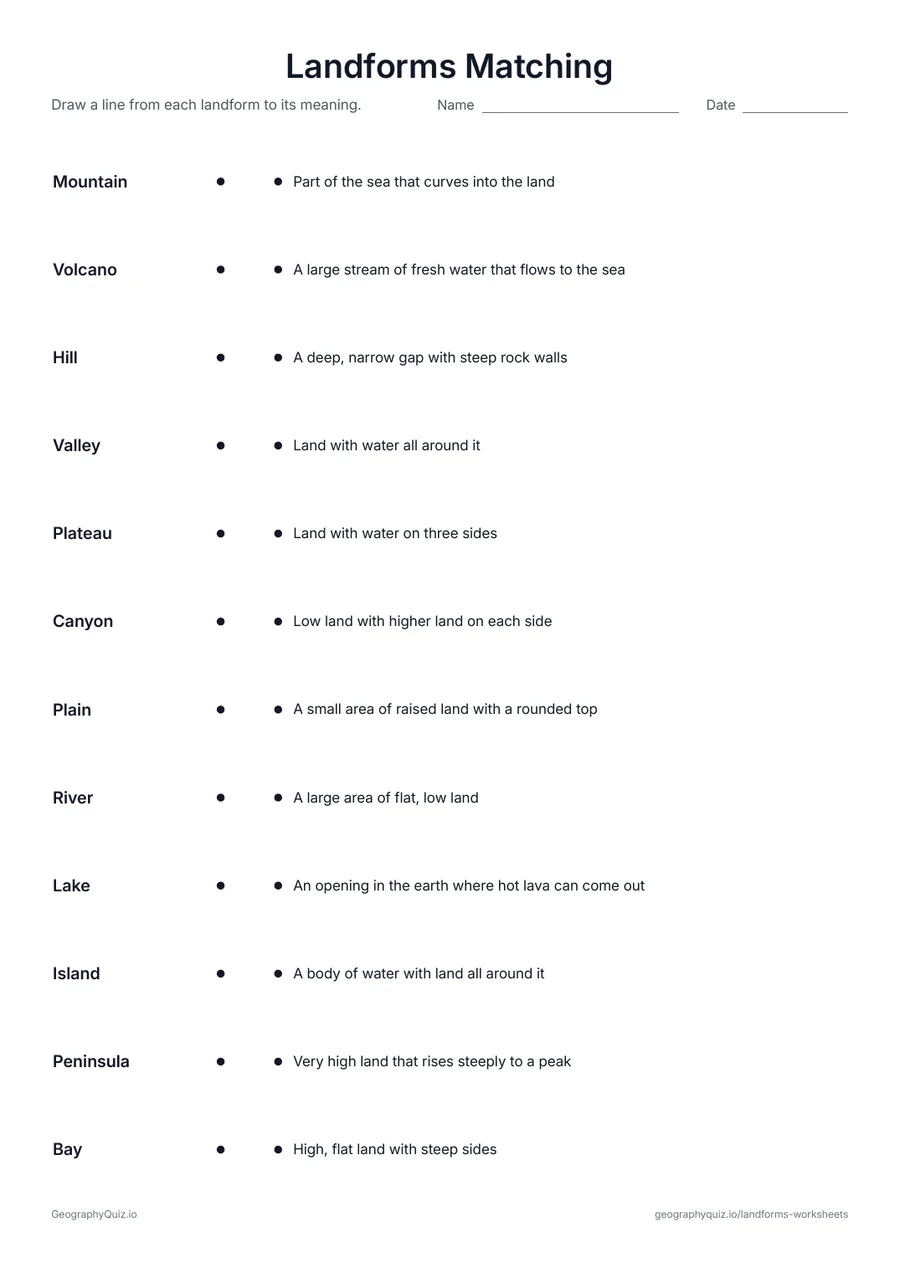
US Letter · 1 page
Twelve landforms on the left and their meanings jumbled on the right. Students join each pair with a line.
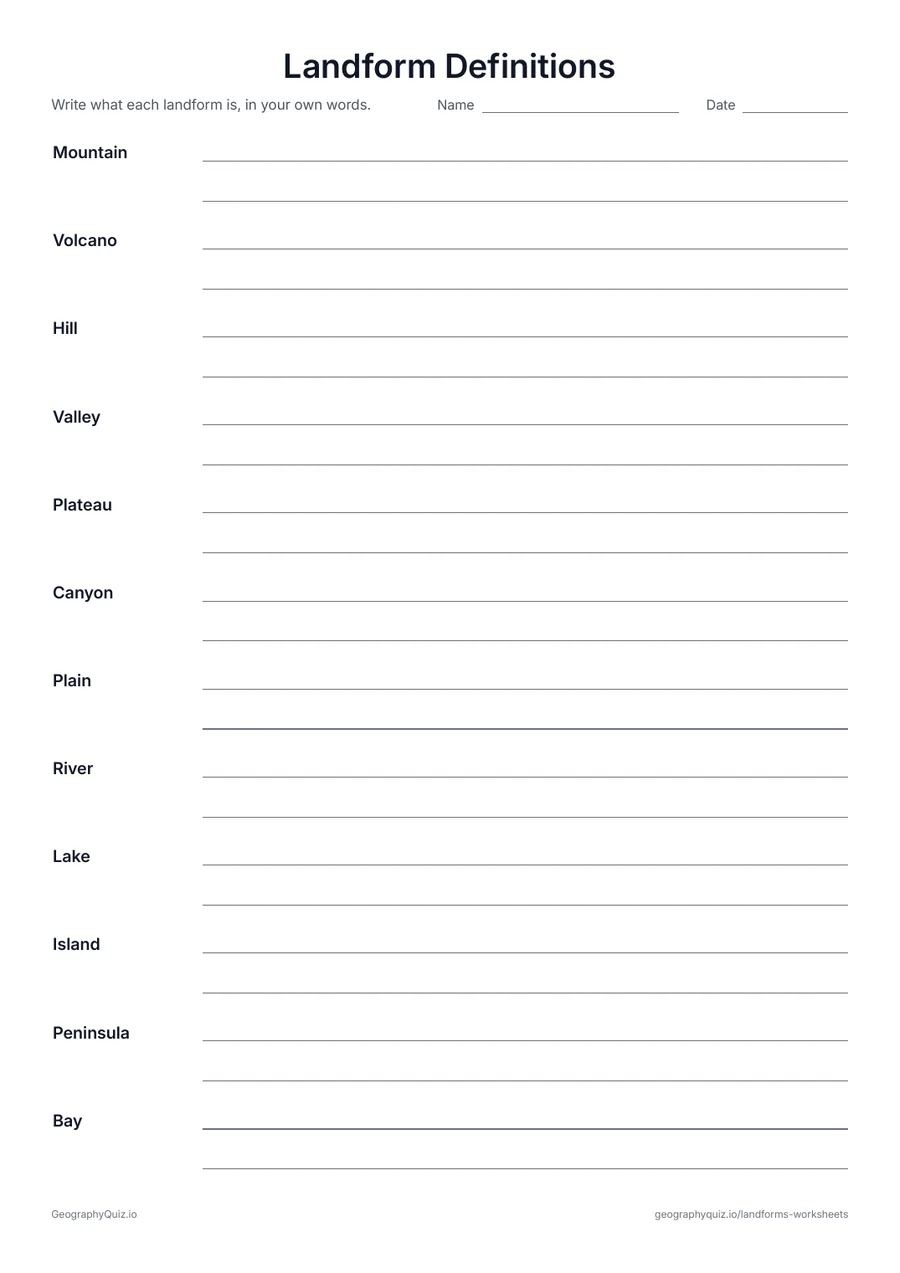
US Letter · 1 page
Each landform with two writing lines. Students explain what it is in their own words.
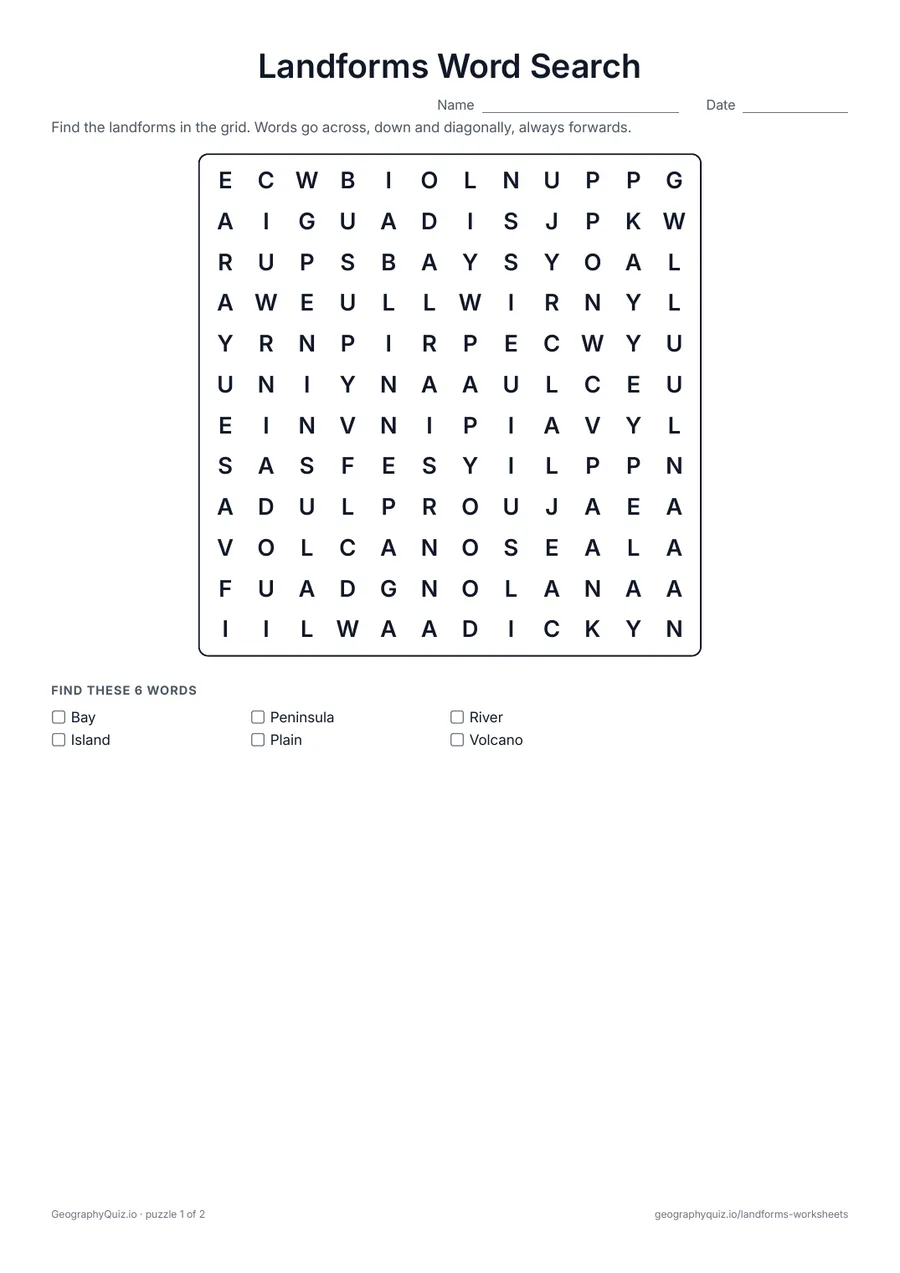
US Letter · 2 puzzles · 12 words
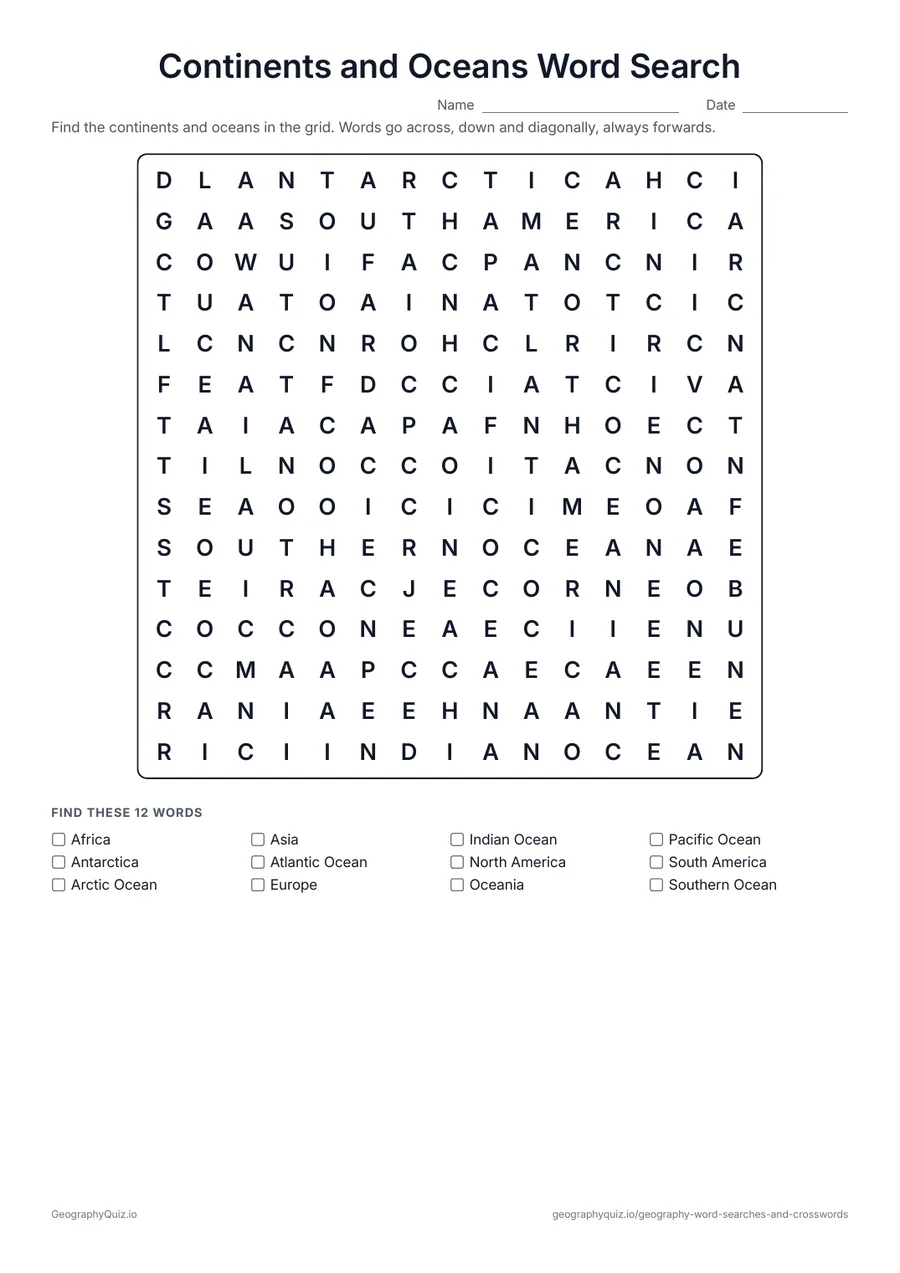
The twelve landforms hidden in two word searches of six words each – a good size for younger students.
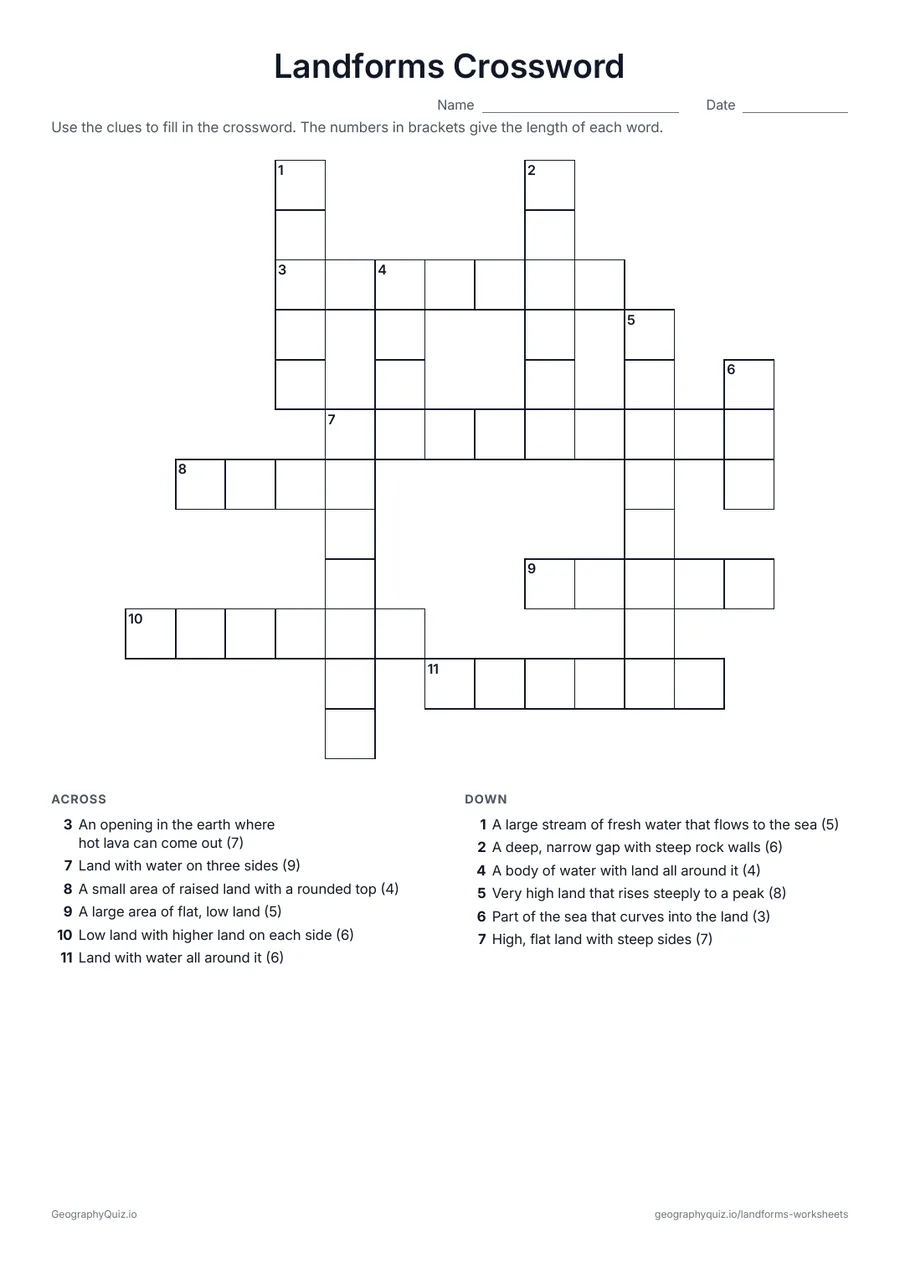
US Letter · 1 crossword · 12 clues
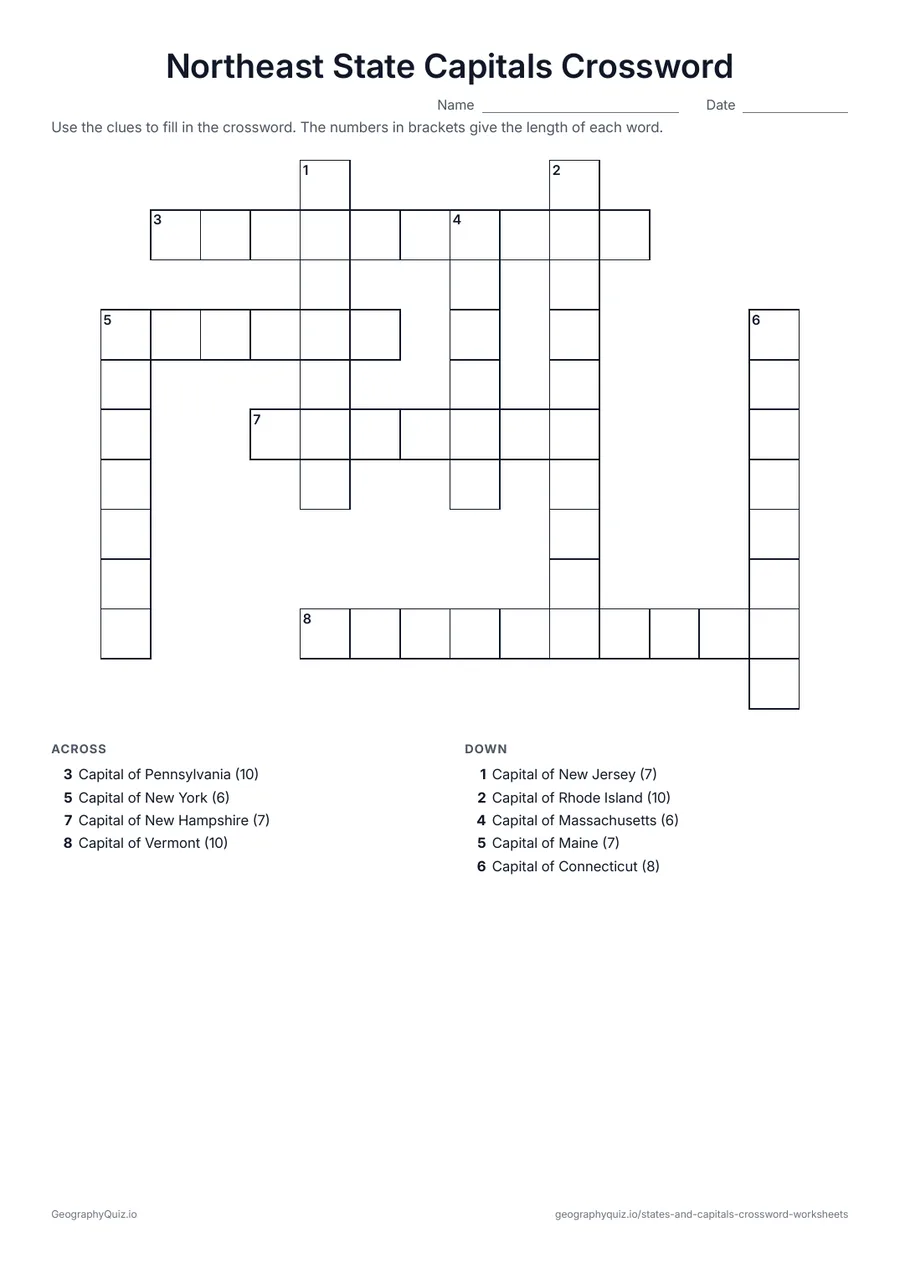
A crossword of the twelve landforms, clued by their meanings: “Land with water on three sides”.
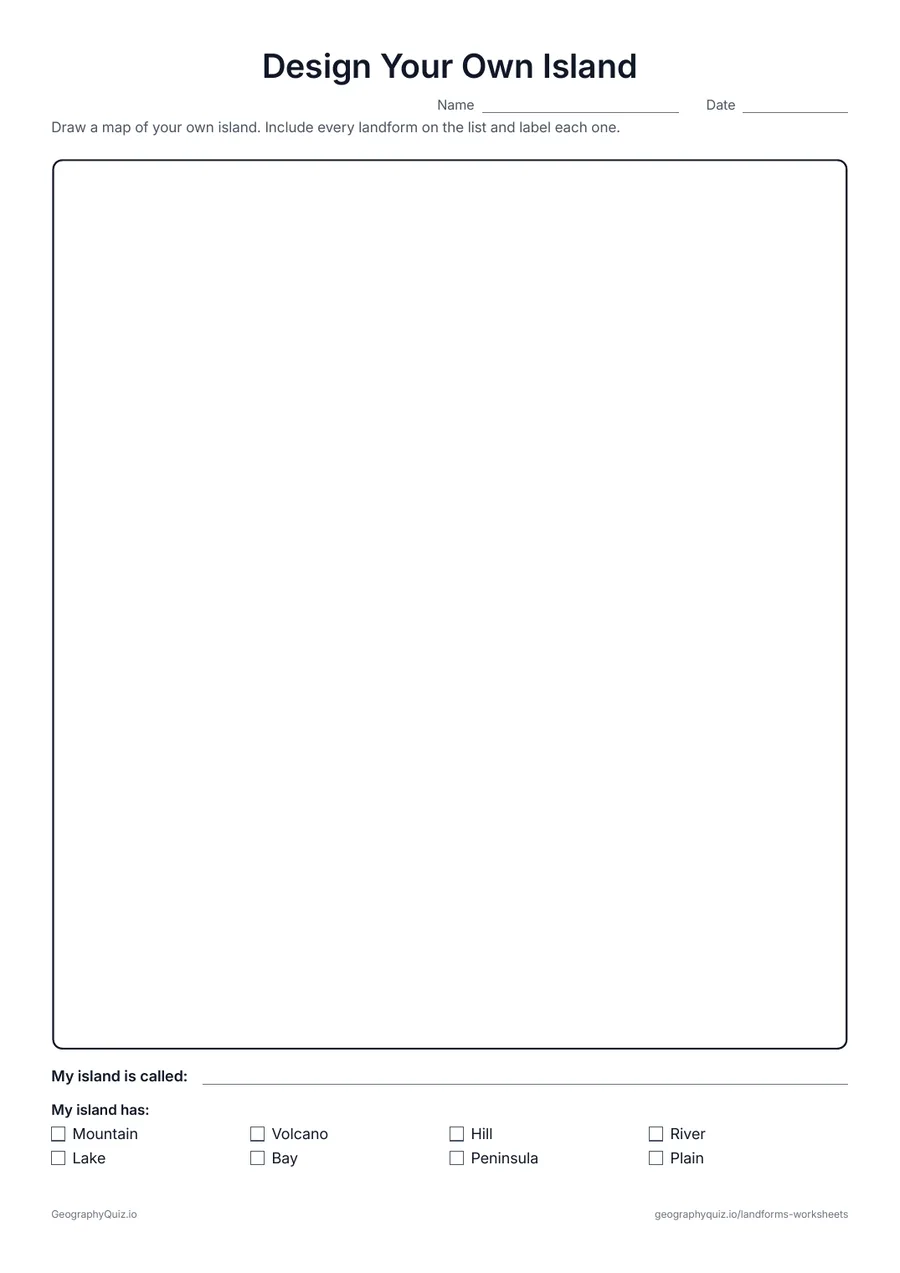
US Letter · 1 page
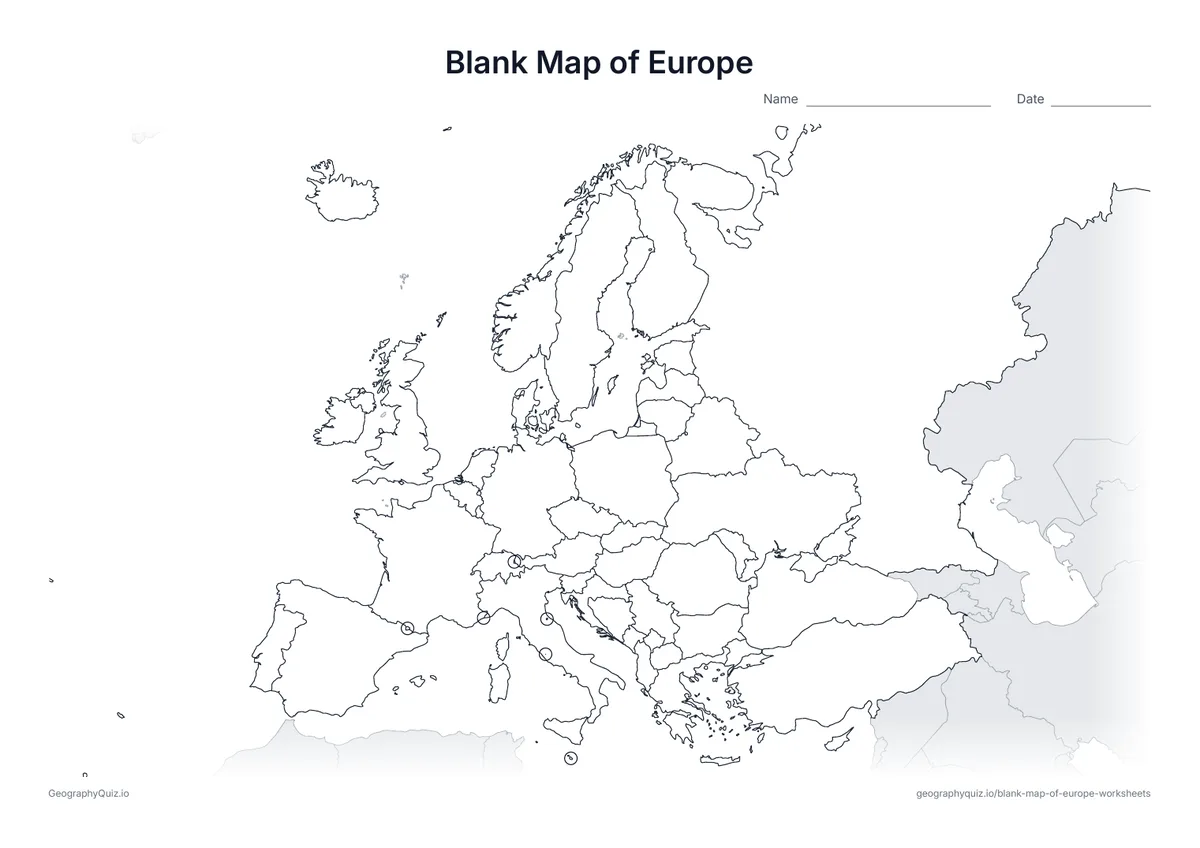
A big frame for drawing an island with a mountain, a volcano, a river, a lake, a bay and more, with a checklist and a name line.
For teachers
Use the labeled diagram to introduce the words, then the numbered sheet and the matching page to check them; the crossword's clues are the same definitions, and the island page asks students to show what they know on a map of their own. Everything prints in black and white, and the puzzles check themselves, so there is no answer sheet.
Every puzzle is plain black type on white, so it prints and photocopies cleanly. Each PDF holds two or more different puzzles, one per page, so a class can share one file.
Introduce the twelve words with the labeled diagram, then use the numbered sheet and the matching page to check them. The coloring page helps students see which features are land and which are water. The word search, the crossword – whose clues are the same definitions – and the definitions sheet build vocabulary, and the design-your-own-island page asks students to show everything on a map of their own.
A landform is a natural shape of the land, such as a mountain, hill, valley, plateau, canyon, plain, island or peninsula. A body of water is a natural area of water, such as a river, lake or bay. Our scene shows both, and the coloring key keeps them apart.
The diagram, coloring page and word search suit grades 1 to 3. Labeling, matching and the island page fit grades 2 to 4, and writing definitions and the crossword suit grades 3 to 5.
The main landforms are mountains, hills, plateaus and plains. Others include valleys, canyons, islands, peninsulas and volcanoes.
Both are flat, but a plateau is high land with steep sides, while a plain is low land.
A mountain is higher and steeper than a hill and usually has a peak; a hill is lower with a rounded top.
A peninsula. An island has water all around it.
Moving plates of the Earth's crust push up mountains, volcanoes build up from lava, and wind, water and ice wear the land down to carve valleys and canyons.
Most US students learn landforms in grades 2 and 3, and return to them in more detail in grades 4 and 5.